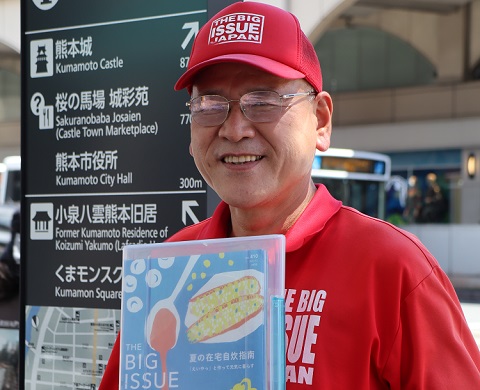

販売者の中西仁志さん The story of Nakanishi Hitoshi, a vendor for The Big Issue Japan
This is my translation of a story that originally appeared in The Big Issue Japan Issue 414.
I translated it as a volunteer so that it could be published in other International Network of Street Papers publications.
The original Japanese is on the left, and my translation is on the right.
This article is also published on the INSP website.
The Big Issue Taiwan translated this article into Chinese.
| (タイトル)
9年近くお客さんに支えられてきた販売場所 精神的につらくても、簡単にあきらめるわけにはいかない ——熊本・びぷれす熊日会館前 中西仁志 さん | (Title)
A pitch supported by customers for close to 9 years Even though it may be emotionally tough, it's not easy to quit -- Nakanishi Hitoshi, in front of Bipuresu Kumanichi Kaikan in Kumamoto |
| (本文)
熊本市内のびぷれす熊日会館前で、見覚えのある赤いポロシャツが目に飛び込んできた。「こんにちは」と声をかけると、「おぉー、どうもどうも!」ととびきりの笑顔で中西仁志さん(61歳)が迎えてくれた。 | (Main)
In front of Bipuresu Kumanichi Kaikan in Kumamoto City, a familiar red polo shirt stands out. When I say "Hello," the 61-year-old Nakanishi Hitoshi greets me with a bright smile and a, "Oh, hello to you too!" |
| 中西さんが『ビッグイシュー日本版』の販売者になったのは6年半前のこと。九州でも数少ない販売者ということもあり県をまたいで買いに来てくれるお客さんもいて、当初は月400冊ほど売れていたという。「それが2016年の熊本地震で300冊近くまで落ち込んでね。最近のコロナ禍では、さらに厳しい数字になっています」 | He has been a vendor for "The Big Issue Japan" for 6 and a half years. At the beginning, because there are few vendors on Kyushu, his customers come from various prefectures, and he sold up to 400 copies a month. "That fell to around 300 copies after the Kumamoto earthquake in 2016. With the recent coronavirus crisis, it's fallen to an even more serious number." |
| 熊本での販売を支えるボランティアの人々からも、「よく精神的にへこまずにいられますね」と言われるという。「いやいや、僕だってへこみますよ。でもね、この場所は前任者が2年半、僕が6年半販売を続けてきた場所。9年近くお客さんに支えられてきたんだから、そう簡単にあきらめるわけにはいかないんですよ」 | He said that the volunteers supporting him in Kumamoto said "You never get depressed." "Not at all, I too get depressed. But my predecessor was at this pitch for two and a half years, and I've been selling here for six and a half years. Customers have been supporting us for nearly 9 years, so it's not so easy to quit." |
| そう語る中西さんは、これまでも多くの困難を乗り越えてきた。生まれは愛媛。海外航路の船乗りである父のもと、きょうだいとともに育った。運送会社に就職した後は、実直な仕事ぶりが評価され、結婚して子どもを2人授かるなど、順風満帆な日々を過ごしていた。 | Nakanishi has overcome many hardships. He was born in Ehime Prefecture. His father, a sailor who worked on international shipping routes, reared him and his siblings. He found employment at a shipping company and was recognized for his honest work performance. He married, had 2 children, and lived a problem-free life. |
| だが、ガソリンの高騰で会社の経営が悪化。部下の不祥事も続き、追われるように職を失った。家族は去り、家は競売にかけられ、手元に残ったのは月々17万円の住宅ローンだけだった。 | However, a sharp increase in fuel prices made the company falter. He was forced out and lost his job due to scandals among his subordinates. His family left, his house was put up for auction, and all he had left was the monthly mortgage payment of 170,000 yen. |
| 「よく『自己責任』っていうじゃないですか。『働いてなかったから、自業自得じゃないの』って。でも真面目にコツコツ働いていても、いくつもの要因が重なって職を失い、ホームレス状態に陥ることもあるんです」 | "They always say 'self-accountability.' 'If you don't work, you get what you deserve.' Even if you keep your nose to the grindstone, you can lose your job for a variety of reasons and end up homeless." |
| 無一文になった中西さんは「犯罪を犯すわけにはいかない」とそればかりを考えて、必死に生きのびる策を探した。そして下関から九州に流れ着き、「寺の多そうな」熊本で寺回りをしてなんとか命をつないだ。 | Nakanishi, penniless, thought only “I must not commit crimes,” and desperately looked for a way to live. He drifted from Shimonoseki to Kyushu, and somehow survived in Kumamoto which “seemed to have a lot of temples" by going around to different temples. |
| 「それこそ、『ごみ拾いでも草むしりでもなんでもしますから』って言ってね。下手したら3日間何も得られないこともありましたけれど、うまくいけば手間賃や食事を振る舞ってくださるところもありました」 | "I'd say, 'I'll pick up trash, or weeds, or do anything.' I'd go three days without getting anything if I wasn't lucky, but if I was, at some places I'd get paid and treated to food." |
| だが3ヵ月もすると「こんなことをしている場合じゃない」と、はたと気づいたという。市役所の窓口に相談するとビッグイシューを紹介され、今に至る。「僕は熊本に身寄りがないから、お客さんとの会話が本当に楽しみなんです。話し相手がいないことほど、つらいことはないですから」 | However, after three months, he realized, "This is not the time to be doing this." He asked for advice at city hall and was introduced to The Big Issue, which brings us back to the present. "I have no relatives in Kumamoto, so I really look forward to talking with customers. There is nothing worse than not having someone to talk to." |
| 数年前にはアスペルガー症候群であることがわかった。「この年で一般企業に再就職も難しいでしょうし、障害もある。僕自身はこの仕事が好きで、これからも続けていければと思っているんです」 | He was diagnosed with Asperger's syndrome a few years ago. "At my age it'd be hard to get work again at a regular company, and I have disabilities. This is a job that I enjoy, and I'd like to keep doing it." |
| 自身の経験を大学などで講演する機会も多い。「今は非正規雇用も増えていますし、コロナ禍で誰が生活困窮者になってもおかしくない時代ですよね。学生さんたちには、僕の経験を通してそういう現実を知ってほしいなと思います」 | He has had numerous opportunities to speak about his experiences at colleges and other venues. "Temp work is on the rise now, and with the coronavirus outbreak, it's not uncommon to find yourself in need. Through my experience, I want the students to understand that reality." |
| 後ろには老舗デパート、鶴屋百貨店が見える
文と写真:八鍬加容子 | (Photo caption)
Visible behind him is the long-standing Tsuruya Department Store. Text and Photos: Yakuwa Kayoko |